March 19, 2025
#2 – Another Word for Surrender (THE FALL OF NIGHT)
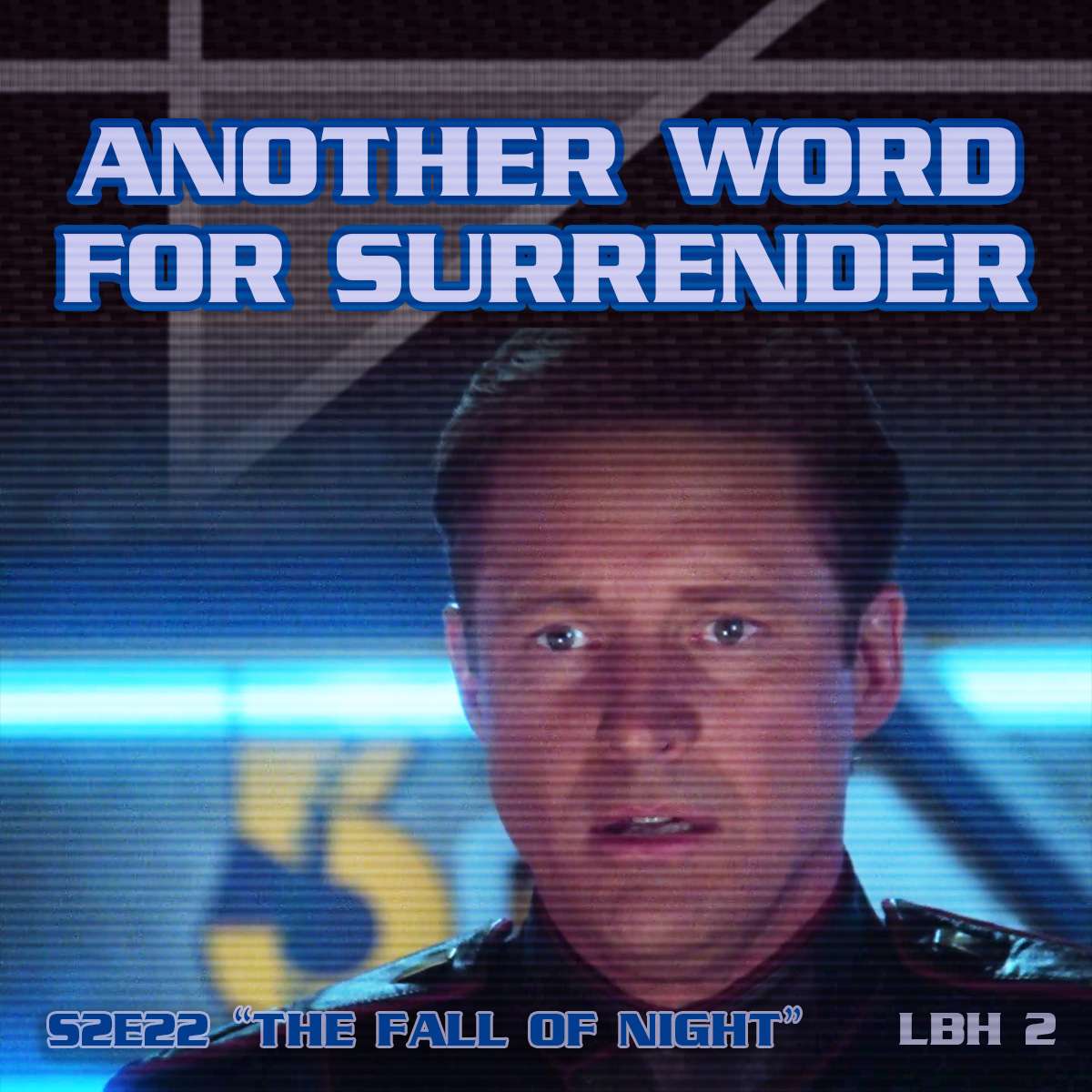
Listen
Transcript
JOHN: Everyone, welcome to your interstellar broadcast of Last Best Hope. My name is John and I'm here with Josh.
JOSH: Hi everybody.
JOHN: Today we're going to be discussing. We're going to be jumping ahead a little bit. We're not going to go completely chronologically the season finale of season two, Babylon 5, called the Fall of Night. It's an episode that seems oddly not only prescient but to be lining up to current events in real time today. And it features the way much of the show does a wrap up of an entire season of plot threads. It happens always around New Year's on the show and deals with major intergalactic political ramifications. But I think as we break it down it's going to be hard not to deny some of the parallels to our own 20th century history. I think which was intended in the writing and which obviously wasn't intended is the parallels to what's happening in our modern day world focusing on what's happening in the US And Europe today. So to start that off, I'm just gonna go where the episode begins which was pretty much just a. It seemed like a regular episode starting off with a training exercise with Sheridan out on his own training the. The pilots of Babylon 5 for specific maneuvers against the Centauri, potential Centauri aggressors. Because for this entire season the Centauri have flipped their role from season one as the sort of empire in decline, past decline, that now the aid of the Shadows. They not only struck back at the Norn but completely obliterated their Homeworld. You know, invaded and have enslaved and conquered the Narn for the second time in, in the history of this world. So Sheridan is rightfully suspicious of and worried about the Centauri and what they might be up to because they've begun to flex their muscle. They are annexing worlds from the Nine Aligned League of Non Aligned Worlds, you know, here and there, but being very quiet about it, denying that it ever happened. And then when it's proven that they did annex a world saying, well, well, we needed that for our security. It's definitely, you know, that is classic. You know, that was World War II. That was the lead up to that Lebens round. We just need some breathing space. Oh, don't worry about. We're not going to come too close to you. And the way Londo portrays that throughout the season of oh, don't worry about us, I'll be diplomatic. And then tirades of anger. Really well done again. I. I think Londo might be one of the you know, just. He captures every aspect of this show.
JOSH: Well, you know, there's a reason why in the gathering, in the pilot, he's the one who gives the very first voiceover that starts off the whole series, the whole saga. Because you're right. Londo, in a lot of ways, is sort of the encapsulation of all of the themes of E5.
JOHN: He really is. And given his ultimate fate, I think it ended appropriately with certain quietness regarding that character without, obviously, too many spoilers. But this is not a spoiler free show. It really was, you know, just sort of a general intro. But we knew something was up with the Centauri. We're worried about that. And we weren't thinking about the greater issues at this point as the episode goes on. And it seems like we get some good news despite all the rumblings that seem really clear that things are happening on Earth that there's a slide into authoritarianism. President Clark has been up to a lot. They had evidence presented from the. The doctor as to there was no mysterious illness the vice president deliberately left. There are all kinds of shenanigans that General Haig has been there. So we know by the finale, we know what's what. We know that there are very dark forces on Earth at this point. Sheridan is aware of the shadows you have in the shot of Zaha Dum. So this is a huge amount has happened in this season. And the characters really are up to date on what's happening on that front. And they're hoping for the best still on Earth. And that's. And that's sort of the vibe at the beginning of this is that we have all these warnings. It really doesn't look good. But there's still a lot of hope that, you know, we haven't fallen yet into this. And a representative from Earth, Frederick Lance, arrives in Babylon 5. A very kindly seeming old man, you know, older man with his attache. Who's the suspicious one? This is the guy. This is his partner in crime who's the head of the Ministry of Peace. And we'll get to that word later, what peace means in this episode. But there it is. The Ministry of Peace under which the Night Watch organization falls. So he's there to oversee, you know, and check out how Night Watch is doing on Babylon 5. And Lance is there to investigate the Centauri situation. And the Crew of Babylon 5 is very excited. They really. They really, you know, they think finally Earth is going to do something. And when Jakkar, the free citizen no longer a representative of The Norn, outside of his influence over the other rebel and free Norn of Avalon 5 hears this and he's elated. He says Earth is finally going to take a stand. And that's sort of what's telegraphed from that initial meeting with Lance and the Babylon 5 command staff is that he's here. The Earth is finally going to do something. And talk about building up your hopes for that. What was, what was your sense like when, when you first see Lance come on board the station?
JOSH: Well, yeah, I think you're exactly right. The way that they're playing it, the way that, um, there's sort of a head fake toward like, oh, okay, like the Earth alliance is finally going to get involved. And it's so interesting because obviously we watched this show the first time 30 years ago as much younger people. So I wish that I could recall how effective that was for me then because I think it's also like, it's not just that we have grown and matured, but also I think we have another 30 years of media savvy and understanding how TV works. So in some ways I feel like someone watching this now would be like, this is too good to be true.
JOHN: You might be right. You know, you try to remember those, you know, that, that 30 year experience and I certainly have moments from the big epic parts of this show. But yeah, I mean, rewatching it, he felt. One thing I'll say about the show is that I always enjoyed the. The day players as the actors came in for one or two episodes. They were usually actors you hadn't seen either for a while or in very much other stuff. And they seemed very unique to Babylon 5 or they were like sort of famous old time actors you really hadn't seen in a while. And this guy gave off, he had exactly. What I think they intended to portray was he seemed like a like 1930s style European diplomat. Even though he's from Earth and was more, you know, Americanized in that sense. He really seemed like that. And obviously I would think they're going to be parallels to Neville Chamberlain and things like that based on what happens. But. And for context for the listeners, you know, what had happened on Narn is, is what we would certainly call. I mean, I don't know even if the word genocide is too weak for what the Centauri did to the non homeworld. Mass drivers driving the entire planet into dust, killing, you know, a population that. I don't remember what they said, but it was in the millions and then taking them over, it wasn't just a military invasion, occupation. This was obliteration, a destruction of everything they had and then occupying them. They were in the narner a completely broken people by this point. I think by any standard, it was considered an atrocity. And Londo himself is on board. I think as the Valyrian is the name of the ship that he watches the mass drivers which is, you know, just basically many asteroids being hurled at the planet. It's like, you know, nukes without the fallout is basically what that means. So the level of atrocity here is really important to put in context. So the other worlds are rightfully terrified of the Centauri because they've just crossed all the lines, all the lines of war, all the lines of. Of ethics. You know, anything that there might have been a shred left, they. They blew past all of it. So in theory, you would expect Earth would say something to object to that because it's in their own interests. You don't want. They don't want that happening to anybody in the Earth Alliance. So you do get this kindly seeming guy and he's very hopeful seeming. There are lines he has about creating a world of peace for his grandchildren that he leaves a legacy. His dialogue, though, is very specific, though. It's very much about him. It's very much how you imagine sort of egotistical ambassador or representative to be. He talked about, I want to leave him a legacy from the old man. That's the line. And I think, oh, okay, so he's making it about him. And that can. Obviously, I think that leads to where his view gets colored. So the episode goes on and he. He's there too. We don't know exactly what for, but he meets with every other world's representatives and ambassadors while he's there. So again, it's real good head fake out. Because you think that, well, why would he be meeting with all these people? He must be trying to assess intelligence and information and figure out who might be a good ally who's going to stand up with the Earth, et cetera, et cetera, and meets with everybody. And the interviews seem reasonable from what we're shown on camera. And then, you know, Jakarta meets with everybody and. And Jakar is not an ambassador. He's not official representative or anything like that. But the crew, of course, say, you know, oh, yeah, you should meet with him. Like, of course he's here. That. Why, why wouldn't you. And mention it to Lance. And that's where we get it. That's the moment that it happens. You see his. Oh, oh, because they have him meet him in the hallway. He goes, I don't have time right now. Sorry, nice to meet you, goodbye. That, that stuttering awkwardness and shock, shock, that was to the viewer, wait, something's not, Something's really wrong here. That's not how he would have react. He should react. And you know, that's when the pieces start to fall into place. Because it's only, you know, a beat after that that he finds out about Sheridan's maneuvers and calls him out and says, you're endangering everything. That's when the viewer can really put it together.
JOSH: So you know what's interesting about that? From what you just said, he said, you are endangering everything I've worked for.
JOHN: I've worked.
JOSH: Yeah, yeah, right, so. So I really think that you're onto something with that observation. And I also think that observation dovetails with something that I wanted to mention with Mr. Wells, his attache, who, by the way, maybe it's because we were just talking about him last week, but I kind of got Mr. Morden vibes from Mr. Wells, the way that in that scene with Ivanova, he basically asks her, what do you want? And he's feeling out whether or not she has the personal ambition that they can take advantage of to get her to do what they want. And I thought that was really interesting because. And unfortunately, I think I have this insight so close to the service because of things that we're seeing in our own government. But like, that's how you get this sort of compliance, right? Like you play to the personal ambitions of people, you give them something that they want, and then they're able to rationalize in so many different ways their position or why they're doing what they're doing. And it's not the worst thing in the world. It's just, you know, and they can even have like plausible self deniability of saying like, well, if it's not me, it'll be somebody else, might as well be me. Right? But the way that dovetails into what you just said about how Lance makes everything about him, like, that's how they see the world. They see it as transactional, which is a very, you know, Trumpian view of things, where Trump is sort of the extreme, where that transactional nature of everything, essentially, like that is what he understands to the exclusion of all other motivations. Like, I don't think he can even conceptualize how somebody may do something for reasons other than self interest. So with that reveals something that I think JMS really nails Here that there is a view of how the world works and how to get what you want and how to accumulate and consolidate power. That is completely about playing to personal ambitions of people. And, you know, we're really lucky or the crew of Babylon 5 is really lucky that, you know, generally speaking, the Command staff of B5 do have other motivations for why they are serving. Right. I thought it was very savvy of Ivanovan, like, she immediately understood what was going on here, you know, because what Wells was saying, like, sounded a little fishy, but also, like, doesn't sound terrible, you know, and there are even ways where you can justify it and make it sound like it's a good thing. But even with that, like, soft cell, Ivanova knew immediately what he was doing. And she went from there, right to I won't betray a confidence or sell out my ideals. Like, she knew that this seeming innocuous sort of arrangement that Wells was proposing here was the first step on the road that goes.
JOHN: And we see what happens with Zack at the same time where it's a different power dynamic because Ivanova is already more established both in her career and her sense of self. Zack is portrayed as character low ranking and isn't really sure of himself at this point in the show. And he figures he's asked to do something even less, in a sense, to him, you know, just, oh, did this guy say something? Somewhat, you know, complain about taxes as a small businessman on Babylon 5. And, you know, can you. Can. You can confirm this? It's like, well, I guess he did complain. It's like, oh, that wasn't very hard, was it? Those two scenes are. Are the same. But you're looking at how you appeal to both different levels of, of people in the command structure and how you manipulate people. Ivanava's reaction, that actually fascinated me because I, in my memory would have thought, knowing, you know, what we think of as Ivanava as character would have had a phone fiery response. And instead it was this incredibly diplomatic, calculated, strong response of a strong no, but she wasn't going to try to infuriate him or she. She realized what a, what a, what a landmine this was. And also that she didn't need to reveal herself as necessarily too sympathetic to the other side in, in this case to just politely decline and indicate that was not in line with how she behaved and sort of put it back on him. And his response, as a result wasn't, you'll regret this. It was, well, the offers open indefinitely, you know, which was also very. Mr. Morden you know, so, so, so that, that she, her character knew how to handle that moment without setting off too many alarm bells with Mr. Wells. And it left that dangling bit of hope for Mr. Wells that, well, the door could still be reopened in the future. Something along those lines. And this, and this prevented her from coming under immediate suspicion, or at least too much suspicion. I think the whole B5 staff was obviously under suspicion. You're talking about the commands of having gone through this. You know, the way they wrote Sheridan in season one, Episode one of season two was that it was a last minute appointment by the president should something happen to him or something happened to the previous commander. And because of the behind the scenes stuff, that's what gets changed. But I thought it was interesting that they established Sheridan from the beginning as somebody who operates from conscience and duty above almost all else. And that the, that the, you know, slain president wanted to make sure somebody like that was in charge of Babylon 5. So obviously we're establishing these are who these characters are. This is what they are. And you certainly hope in a modern world, well, we have those people in those similar positions now, but their chicks may not have worked on them. But it was an eerie sort of B or C plot to this episode where we said, oh, this Night Watch stuff is not good. Because by the end of the episode we see the consequences of it. You see that when Zach confirms just a little rumor about somebody complaining about the government, the shop is shut down. The guy is, we assume, arrested, and a sign goes up, ministry of Peace shuts down this business under, you know, because of sedition. And you say, oh, wow, okay. So that one little comment and just a confirmation and getting somebody locked in, and now Zach is going to feel guilty about that. But weirdly enough, that kind of guilt doesn't move somebody away from participating in something like Night Watch, which is equivalent to, I mean, it's, it's not just, it's not just when we think of World War II, it's just as much analogous to the Stasi and East Germany where everyone became a spy on each other. You know, speak out if you see something and report, you know, your neighbor, report anybody for anything suspicious. And that, that move, you'd think would, would turn him off to it. And it did turn Zach off to a point. But the more that kind of fear gets reinforced, I think the more likely somebody would be to do that again because they realize, oh, that's going to come back at me if I don't play ball, continue to play ball. So we Obviously see in season three how that plays out, how, how he has to make his decisions. Garabaldi has to deal with that. You know, it's, it's very telling, but it's these little, little actions that can matter as much as the big ones. Because obviously this episode has the big ones on the, you know, on the Centauri Norn Earth axis. But this was, this was a real important aspect to have in there too, because it's really easy to lose sight of. Well, that's the quote from Sheridan. I think later on is it's easy to lose sight of the big, you know, if you lose sight of the small ideals, how do you have the big ones? This show is always about, we're going to show you the small ones and the big ones. You said in our previous episode that JMS realized that this was a space opera intergalactic political drama and a personal sci Fi story. And actually the two are the same thing. And so we always get both those things happening in parallel. And that happened here. And as the episode goes on, I just, I had a little bit of chills. I was thinking, oh, this can't be. This can't be what I think it is. This can't be going where I think it is. I think I told you before we started recording that I'd actually watched this episode before this week's news came out regarding the negotiations between Russia and the US Regarding Ukraine. And seeing that news unfold and then having only a day or two previous and watched this episode, I sort of laughed darkly like, you got to be kidding me. Is somebody just reading a playbook of what to do and follow down sort of the, you know, how to be almost a. How to call it like a comic book totalitarian. Like you're just following a plot line. You're not even detailed, deviating from it.
JOSH: Yeah, well, so, you know, it's funny you say that, because what I've been saying for damn near a decade now is just something that adds just enough insult to injury about this particular authoritarian power grab that we are living through is happening is that these are cartoon villains. They are so transparent and mustache twirling caricatures of what you would expect the real thing to be. Like to the point if you were writing this, you would get notes about how unrealistic it was. Like, you know, and I think I said last time, when I revisited this show in the early 2000s, I kind of thought, you know, maybe B5 is a little heavy handed. Right. And given the reality of what we're living through and what we're seeing and how it's really playing out. It's not heavy handed. It's not heavy handed at all.
JOHN: No.
JOSH: You know, and you were saying that it was as if they were reading from a script or like a prescribed playbook of some kind. And I do think that it reveals there are some. Not intrinsic, but like through some combination of forces, historical, political, similar dynamics end up playing out. Like, what is the quote? History doesn't repeat, but it rhymes.
JOHN: Hmm. Yeah, I've heard that.
JOSH: Right, so. And it was interesting, like when this was written, the early 1990s, the freshest or most top of mind examples of this authoritarian situation. The two examples that are. Were most top of mind then were Germany in the 1930s and some aspects of the Soviet Union. And so you mentioned before, the illusions here are mostly referencing those things you were talking about. Mr. Lance, who, by the way, that actor. The only other thing I've ever seen him in was the first episode of Space 1999. He plays a very similar character.
JOHN: Interesting.
JOSH: And I know that JMS was a big fan of British tv, so I almost wonder if, you know, he saw his headshot and was like, that guy. I want to get that guy. Because he had seen him in Space 1999. But that's an aside. He said there are shades of Neville Chamberlain. He literally says, we shall know peace in our time. Which is a direct Chamberlain quote. And then in the closing montage when Ivanova has that voiceover at the end, there's a shot of Londo in the council chamber where he's like, very physical, like very emphatic, and he's shaking with rage. Yeah. And I think it was on. JMS did a commentary for this episode on the season two BD set. I think that's where I'm getting this from. But that performance, Peter Jurassic was watching videos of Hitler's speeches.
JOHN: Interesting, interesting. That fits.
JOSH: So. And it was a direct. Yeah, so it was a direct sort of visual illusion to once again, like that memory of Nazi Germany in the early 90s that was still in living memory. Right. The generation that lived it is almost completely gone. So I did have the thought. I know JMS wrote Pilot a proposed reboot of Babylon 5. And it makes me wonder how he would have handled these same themes with 30 more years of history. In hindsight.
JOHN: Yeah. I mean, you have. You're right about the living memory and the fact that because it was both living memory and because it was. It was victory by the Allied forces, the Axis was broken you know, the. Well, I should say not the Axis. It was, you know, it was. Germany and Japan were effectively broken and rebuilt. Unlike the First World War, they were rebuilt, incorporated into the world. When the Soviet Union falls, as we referred to before it was considered yet the Francis Fukushima idea, the end of history, this is how it's going to be. Democracy, particularly what we call liberal democracy, meaning preserving rights over even majoritarian rule and democracies is the way to go in the future. So whenever a writer or an academic were, you know, or, or a commentator on the news was to bring up, oh, well, that's like fascism. Oh, that's like authoritarianism, they were immediately looked at and say, oh, hold your horses on that. That's not. It's like we had that, we defeated it. It was almost like, we can never go back there because we defeated it. And again, living memory, we defeated it. That doesn't come back. We won. And you're now exaggerating something and as a result weakening your arguments. So for a very long time, if somebody made a comparison, let's outright say, if you compare it compared somebody to the Germans of World War II, you compare them to Hitler, they were saying, well, you've just lost intellectual debate. I was told that in school, I was told that college that you, the moment you bring that up, it's like you've just given up the argument because you went so far over the top. And it's not saying people don't argue over the top, but the weird thing about that is it nullified the ability to objectively examine history and that it wasn't, I use the word magical, that's not an academic term. But people think of the Second World War as magic or fantasy. That it was so out of reality, it must have required these very unique circumstances. It was this particular villain in the form of Adolf Hitler, a particular series of things. And it was the evil, evil Germans who must have followed him, realizing, no, no, even right after that you have Hannah Arden, you're talking about, like, no, it was the banality of evil, the simplicity of just everybody going along to get along. There was nothing particularly super powerful, super unique, certainly not magical or fantastic about him, even though he was very occult interested. And we've made that up in the way we teach our history and as if this is an inaccessible thing to us and that it's almost an oddity of history when in fact the only way to prevent authoritarianism is to look at it through a very clear eyed, rational perspective and say this happened very simply. And relatively easily and can happen again. We've all heard it. The price of freedom is eternal vigilance. Well, we've dropped the ball on that for decades now. And we did it in part by denying the fact that we can argue parallels. Because the rest of the world, outside of our sort of US bubble here, has had many strong men, authoritarians all over the world, many as a result of actions that were taken internationally by the world's superpowers, the Soviet Union and the US throughout the 20th century. So we have examples all throughout the 20th century, in the beginning of the 21st century. And again, everybody sort of like, no, don't look at that. So I think even in writing like Babylon 5, it was seen as okay. If you make those references, you can be seen almost as too alarmist. I think he just went in full speed to this and said, okay, in our 200 year future, this scenario, like the 1930s and 40s, is unfolding again. And that was seen as acceptable because it's 200 years in the future. It's way out there. It's a fantasy world of a station in space. Like, it's just separate enough that no one's going to quite argue that you're being too hyperbolic or too crazy about it. And that, I think, is the big message we need to take here, is that, no, no, that's never the case. We actually always need to be studying this. And that's, I think, why this show is one of these examples that does parallel. Because it wasn't, it wasn't doing something unique to itself in terms of history. It was unique in that it portrayed it without trying to filter it for a modern audience and saying, oh, but that would never happen here. That's the phrase. It would never happen here.
JOSH: No. Yeah. I mean, there is certainly a way that we treated and still treat the Second World War as, you know, some sort of aberration instead of something that's, you know, the dynamics of play replicate themselves and occur, I think, with more regularity than recall. Comfortable with that we're comfortable acknowledging. And there was something I read the other day, someone on social media, I forget what exactly they said, but it was something that's sort of like a genre of tweak in the Trump era. Something to the effect of, like, if you ever wondered how you would react in 1930s Germany when Hitler was rising to power, you know now exactly how you would react. And the same way that I think the tendency to villainize or dehumanize the everyday Germans as somehow particularly Monstrous somehow I think is a mistake because I think, you know, as we are seeing. The thing is, I just heard somebody say this the other day and I wish I could remember who it was. They were basically saying that what allows them to be clear eyed about what's happening right now and not fall prey to the trap of authoritarianism and fascism and going Maga like he was positing that the difference between him and MAGA people is that he acknowledges that he has the capacity within himself to become, you know, a Nazi. The way that Civilian Germans in 1930s and 40s became a party to great atrocities and great horrors because it was all done in their name. And maybe some of them didn't like it, but like what were they to do?
JOHN: That's, that's a really important point though is, is the most, the most uncomfortable thing I think and has and has. I feel my, my body's tensing just thinking about that because I want to react, to say, no, that's not possible. It goes against what we're taught, you know, that, that that's possible. I think one of the wisest things a person can realize is that that capacity was profoundly human. It wasn't unique to a people, to a culture, to a part of the world. Again, it wasn't this idea of there are a few evil people, a few good people in the world, and that's how history always plays out. So I really, it's a, it's a difficult place to go. And for a commentator like that or, you know, somebody quoting that, saying, no, I see where that could be in me, that's a, that, that's a form of self examination, self awareness that I think few of us even have, is to say, hey, I see where that could have happened to me because obviously it happened to millions and millions and millions of people in 1930s Germany. And there's so much literature out there on how, on how that happened. And most people are not educated on that because it's very, very uncomfortable to realize that we all are a couple steps away, depending on the circumstances. And if we don't realize what's happening or we don't want to realize what's happening. And I love what you said that you know how this is the time you said, well, how would we have reacted if we were in 1932 or 33 or any of those years? And this will show a lot of people. But the important part, which this show, to very quickly jump all the way ahead because it is television. Eventually the good guys win, but it doesn't happen in a way where it's just good guys. When we go home, credits roll, celebrate happily lived after. It's a very difficult process. But what's said in the end, after this was not a process of demonization of those who followed President Clark, those who followed orders at all. In fact, it's a complete reconciliation of saying what you did was wrong. And they even accused Sheridan of, like, saying, well, the way you came back at it was also wrong. There's no right. There's no easy way to adjudicate that. But the point is afterwards, not to say, oh, but I'm so much better than you because I. I was on the side that freed us from President Clark. It was a recognition of that core humanity, saying, but very easily I could have find myself on the other side. And I think realizing that in times like now say, okay, there isn't this chasm between the sides in this country. And that means that it doesn't excuse anybody's behavior, but it means, oh, you can understand why it's happening. You can see how tempting and easy it is to fall into. And that's again, the slow buildup. This, this is happening over multiple seasons. This wasn't a story where, you know, season one, incredibly slow on. I mean, season wasn't slow, but it was only morsels of the story. Season two ramps it up. You still think, we're gonna get there, we're gonna save the day. This won't happen. It does at the end. And that's the recognition of, oh, it is the people who you thought are just regular, everyday people who fall in line with that regime. And that's. And that's sort of what you see in this episode, whether it's Zach, whether it's the res and then, which we'll get to in a minute, is these Night Watch spies ratting out Captain Sheridan and the Narn refugee vessel. And I think it's a good point to take a quick break and we'll come back with, with the heavy hitting stuff in this episode. I think we've had a lot of good build up and oof. This, this once, once the agreement is announced, once we find out what Frederick Lance was there to do and when the Norn refugees show up. Oh, this. The whole show takes a different tone. So let's dive right back into the episode and really the meat of it, where it gets going now and where the parallels come in, you get to the middle of the episode and you're beginning to suspect something's not right. Obviously, with Night Watch there. You're like, okay, we know it's not right. And a Narn cruiser comes through the jump gate. They're crippled. They've been. They were in deep space when the homeworld of the Narn was bombed and the fleets were destroyed by the Shadows and the Centauri. And they've been limping along ever since, trying to survive. And Babylon 5, following the laws of the Earth alliance is going to give refuge to help resupply and give medical aid to, you know, basically so energy for their jump drives and medical aid for their crew. And. And Sheridan, realizing the nature of the Centauri and, and this conflict as it's larger says we have to hide this because if, if, if it leaks out from station, of course. And there are millions of points that can leak out or hundreds of tens of thousands based on the number of people who live there. They can, you know, this in. Tory would show up and they would not recognize the neutrality of that space. So he gives them eight. And it seemed like, okay, this is our heroes doing the heroic thing. This is what you expect of Babylon 5. And you feel bad for the Norns. And they're going to hopefully be able to get off on their own and go, you know, on to another day. At least as a few free Narns would be. It's a Night Watch member in command who overhears what's, you know, obviously is part of what's happening and reports it to Mr. Wells directly. And this is. This is meant to be after the scene with Zach Allen where she's also there like, okay, this is very interesting. And you see her expression in CNC like, oh, I better. I. I think this is something of note that Mr. Wells wants to know. And again, she's not a. She's not meant to be a villain. She's meant to be. Yep, she's in on. She. She believes in the Night Watch and is a member and will report that to her supervisors. So Lance shows up furious, much more so than about the maneuvers earlier and is absolutely freaking out and reveals everything that we are here to make a non aggression pact with the Centauri. We are not going to call them out on their atrocities. We are not going to come to the aid or at least draw a line in the sand where the other Non Aligned Worlds can stand to stop Centauri aggression. No, we are going to enter into a non aggression treatment agreement that enables the Centauri to continue their war of expansion and leave Earth safe. The crew is aghast. And that immediately Puts a threat, keeping this ship secret because that was, you know, they'd just been ordered to depower there or asked to depower their jump drive in order to finish repairs. And there it is. Because Night Watch is aware of it. The station leaks, the Centauri show up. And the big moment of the episode, the climax occurs. A massive space battle. Babylon 5 has upgraded weaponry. Due to the events of the first season and the increased perception of, you know, with the Centaurian, the threats to the station itself and tensions rise and rise. What are the Centauri going to do? What's Babylon 5 going to do? And how do you get. And Tyrannos is like, no, we gave them aid. We gave them aid. We will. We will make sure that they are safe when they're in our space. When they're in our jurisdiction. Once they're through the jump gate and past our jurisdiction, that's not our problem. We can't. We have no authority over that. But they will not be harmed in front of us. It's a classic hero moment. Sheridan saying, like, you're not gonna. You're not gonna punch them in the face in front of me. You're not gonna kill somebody in front of me. And the Centauri don't even acknowledge Babylon 5. They basically just start firing at the Narn and. And the station. That was a surprise that you think, like, oh, there's gonna be a diplomatic back and forth. No, they just fire first. And they, you know, just. And the station gets its little, like, mandible. Mandible is. Is. Is. Is almost ripped off. And Sharon's just like. And he's angry. He's like, fire back. Defend us. You know, like, we have to do what we have to do. And I love how in this show, this is that nature of the sci fi combat attempting for little bits of realism but drama in the moment too. You don't know how your weapons are going to be. This isn't the target. Phasers on their engines only. Just disable them. It'll be fine. Moment. This is. We're firing back. We hope to only disable them, but we have to fire everything. We've got the station on leeches. We get this big CG moment for that episode and one of the best up until that point. And they do disable the Centauri ship and then some. And they realize very quickly how bad the damage is. Scramble the medical chips. There's not enough time. And the Centauri ship blows up in front of them. The horror on everyone's Faces was palpable. It was, oh, not only is this a humanitarian disaster because they didn't want to kill the Centauri. The. The weight of that in terms of the diplomatic interactions, what that meant for. Could mean for the future was huge. And that was what you sort of expect of our heroes in the show.
JOSH: When Sheridan says, describe all the medical ships. There's still time. And then Abonova's like, no, it's too late. And Sheridan realizes that it's about to blow up. He goes, oh, my God. Do you think in that moment he's thinking of the political fallout or all of the people who he just murdered or not?
JOHN: My initial reaction is I think he's thinking about the people. Yeah, I think that's how. And that's how he was as a character. I think Bruce Boxing did such a brilliant job at portraying this because he comes in in the first episode of the season and they tell you his history. He was the one who know blew up the only Minbari cruiser in the Earth Minbari War. And he never celebrates it as a victory for the sake of, oh, I was able to beat them. He takes this very philosophical approach of we are trying to save ourselves. I found a way to finally beat a ship. And he. And he has no compunction that it was Memorial or I write that he was dishonorable by mining a land, by mining asteroids to take out the ship. That it wasn't a face to face thing. And he was just like, no, we did what we had to do, but we took no joy in it. We're not. We're not rah rahing about it now. That it was a huge piece of morale booster for the Earth Force. And in the beginning, years later when we get to see the prequel, we see him do that in his past and it's the same thing. He's not celebrating the death of his opponents. He almost mourns them. And that is sort of the philosophical warrior aspect of him. He is a bit of that. I think Sinclair became. If Sinclair had stayed in the show, Sinclair was definitely the warrior monk type. Sheridan is not quite the that degree. That's why he very much works at Sinclair becomes. Becomes Ranger 1 and Valen, but Sheridan's still similar. And I don't think he would look at this as anything more than, oh God, what have I done? You know, I don't want this to happen. He regrets it every time he has to do that. He says it to Bester after he's retaken Earth. He says, that's the difference between you and I, we both make really hard choices. But you see it, you do it.
JOSH: Because you like it.
JOHN: You like it. Yeah. I carry it with me. And he's not making himself to be a saint. He's like, I will live with these things. I have to carry the consequence of these things. Pastor just enjoys it. He loves playing the game, and that's why I think he really. You're right. What a good moment. There are so many little moments. I think we got so lucky with the show, with. With the cast and other things. I think there's a lot of. I'll call it kismet in this show of just factors that work together that they didn't plan. This is JMS's first show to ever run. He didn't have every piece lined up. Oh, this will work. Because this will work and give the perfect notes. I feel like people just knew. And Bruce Boxner especially got it and said, I know who Sheridan is. Rewatching the season has been a delight because I see, oh, this character knows exactly who he is. There's no, wait, what is my motivation again? You know, completely. And a lot of other characters get that, too. And now we go on and we see, you know, what's the fallout from that? And you think, oh, well, this will be a moment where this is just too far. The Centauri will pull back and this will force Earth into a conflict of the Centauri. No, no, we don't even get that. A moment later. Lance is like, well, they're pissed, but they're being magnanimous. Just means, you know, they're working in the background. All they're going to do is they just demand you apologize. And Sheridan's just like, oh, his. His little speech in the mirror there was really good performance.
JOSH: Like, I love his line reading at the very end where he repeats what Mr. Wells said to him, where he just. He says the exact same words, but with just a different inflection. And I love Bruce Boxleitner's performance, the way that he says it. He's like, as with everything else, it's the thought that counts. Yep, it's this. It's this, like, very subtle, nuanced thing that he's doing in a show where I feel like, because the. The intention and the emotions are. Are very often larger than life. You know, this was a moment, a scene in the show which I really credit JMS for finding these little moments, these small moments in the show because he understands intuitively that this is actually where the show lives. So you have that small moment where it's just Sheridan alone, he's talking himself in a mirror like that. Seeing that is just as important in terms of what the story is trying to communicate, of what it's trying to convey as seeing the. The way that it actually plays out. The other moment that I loved is this scene that. It's like a legendary scene, but in the context of everything we have been talking about and everything that we're going through really struck me. It's. It's near the beginning of the episode where Vere and Lanier have a little moment in the Zocalo where, you know, talking about all the stuff that's going on. And, like, they're. They're not telling me everything and, like, things are happening. I know it, but blah, blah, blah. And then they both say at the same time, makes me nervous. And they look at each other and they have this moment. These two characters from places and cultures and backgrounds that probably are the most diametrically opposed. But in each other, they find kinship, community, camaraderie. And both of them are really surprised at moment because I don't think they really had any thought or intention about what they were doing or saying to each other. And it really spoke to me because, I mean, once again, it's another one of those small moments. You don't need to see that to. To understand the story, the plot of this episode. But it. It kind of took on a different valence for me watching it now in February 2025. Because it really reminded me of something that a lot of people, you know, left of center have been saying in the past few months. Is that the thing to do right now is strengthen community. Check in on your friends, reach out to strangers, like, show kindness, show embassy. Because that's how we're gonna make it through this. And that's what that scene made me think watching it today and was actually rather moving. It's like in the midst of all of this, like, they sort of found each other and they shared this human moment. And that was the nourishment that allowed them to move on with their very stressful day.
JOHN: Maybe this is what really helped the show work the way that it did, you know, and why he realized the two ideas were the same. Because he wasn't just going to tell this grand space opera story. It was going to be these very personal moments to the characters, to the residents of Babylon 5 from all the different worlds. And that's something that I think is really rewarding to watch as a viewer. And Is very difficult to squeeze in there sometimes when you only have 44 minutes to put everything you want in there. This episode, amongst many others, feels very dense. You get so much out of every few minutes. The plots, you know, invert themselves practically. You know, you think it's going one way, it goes another way but there's also this other stuff happening. And then there's a human moment or I should say a character moment. It's. It's something that I really appreciate about the show even if I wasn't aware of it while I was watching it. But it's why I cared about the characters so much. It's why we were so obsessed, talking years ago about, you know, Jakar's story arc. Because you. You start off the show and you think one thing, then you think another, then you think another because everybody's growing and evolving. You don't get that just in plot points. You have to do the character work for that. And we definitely got some of that. But let's. Let's dive into the deep of where this episode really hits hard today. I mean, we've been talking a lot about the Narn and the story conflict. We've sort of set up what that means. The Narn were. It's a little bit different than modern times. The Narn were getting aggressive. The Centauri were empowered by Londo and the Shadows and became an incredibly powerful force that completely subjugates the Narn starts invading other worlds reclaims their grand destiny in the stars. They have their cultural moment looking back at their heritage and saying, we are dominant again. And that really does have a parallel to Russia and Ukraine. You know, two. Two countries intertwined by history and conflict and different claims. And in the modern era, there was a country. There is a country separate from Russia. Separate identity, separate culture. And like any country, there are different subgroups within. But we've. But we've seen that. And they were coexisting. And unlike Babylon 5 where the Narn provoked enough to give the Shadows an opening to get to Londo there's no clear provocation except via ego. Which maybe is the parallel because the Centauri were feeling beaten down. The Russians are the def. You know, have been the defeated empire. They were. They were the world's superpower fighting with us over the title of who is Number one? And then the Soviet Union collapses and they've been in a state of who are we? What are we? And their leadership has always been about reclaiming. Since the beginning of this century, has been about reclaiming. Their place in the world, their, their, their, their view of honor and dignity. And there was no reason for a conflict between the two countries. On, on, on a, you know, purely tactical level, there's a lot of writing about that. Oh, if it wasn't for this, it wasn't for this. At the end of the day, there was no reason for an invasion. It happened out of ego, out of nationalist identity and a view of cultural domination, one against the other, and how it goes back and forth. So the country's invaded, surprisingly, is able to defend itself, and the US Acts as we assumed Earth would have acted in that moment, to at least back them up and say, hey, you can't invade them, you can't threaten your neighbors. Your claims are not valid. You can't do this. And we've sort of been in this stalemate back and forth for three years. And shockingly, what this new administration has done and what Trump did was he comes in and not only says, well, I'll create peace and we'll get to the word peace in a moment. He says, I'm going to do it without even bringing in Ukraine or the Europeans who are also threatened by Russian aggression. None of them will be part of it. None of them were part of it. I couldn't have imagined somebody telling me a year ago or two years ago that, oh, the, the, the negotiations for the, for peace in Ukraine are going to be not inclusive of the people of Ukraine who are invaded.
JOSH: Yeah, I mean, they're not really negotiations for the end of the war. It's like, how are we, how are.
JOHN: How are the two big powers going to decided ends, I guess.
JOSH: Yeah, right.
JOHN: And, but that is, I mean, the Earth alliance was saying to the Non Aligned Worlds, you are all on your own. You are on your own. We have a deal with a Centauri. They won't come after us, we won't come after them. We certainly won't restrain them from doing whatever they want to do, and we're going to go do our own things. That is, that is what the negotiations are right now, then pivots and Trump says outright when, you know, making not only false claims, whether it was the popularity of, of zelinsky being at 4%, which is literally a repeated notion of Russian propaganda that is demonstrably false, or.
JOSH: That Ukraine started the war.
JOHN: That Ukraine started the war. And that is sort of this, you know, you know, this back and forth of like, oh, well, it's like accusing, you know, an abuse victim of it. Well, you brought it on yourself. That's what I really hear, you know, and Trump might even be thinking that it's not that like literally started it by firing the first shot. It's that, no, you brought this on by your. Yourself by daring to turn away from them. And that was an offense. So there's. There's a lot. It's the kind of decision that realigns an entire planet or an entire galaxy. The Non Aligned Worlds know they're on their own. NATO knows Europe knows they're on their own. Now, there's no. There's no concept now that the US Is going to back them up or Russia or anyone else threaten their countries. It's very clear that's the idea. You would never exclude the stakeholders of the Ukrainians and the Europeans from any negotiation and hold it in an entirely other part of the world. It's not even. It's not even neutral ground, I guess, but it's insane. And then to go after the leader of that country using the talking points of the other one isn then does that in this episode where they begin to talk about the Centaurian very glowing terms and how great this agreement is and what kind of prosperity it will bring. Well, it's obviously not going to bring prosperity for the Non Aligned Worlds. Minbari aren't under threat. That's why it's the Non Aligned Worlds. But it's really a shocking corollary. And it's only done for the sake of authoritarian power cozying up to other authoritarian power. And that was. I mean, yeah, you have a viciously powerful Centauri regime trying to spread out and conquer its section of the galaxy. And we even know what it is based on. When Londo tries to extricate himself from Morden, he says, this part you can have. The rest is ours for the Shadows, you know, And Earth is doing the same. Yes, we know they're being pulled and the strings are being pulled by the Shadows. But the Shadows are very light touch as portrayed in this show. They're not doing it for the games of trying to take over Earth or Suntory Prime. That's something that's really important in the storyline of the show. It's not classic Empire layering upon Empire, layering upon empire. They are these Ancients who have a philosophical grievance with their opponents and use everybody else as a cat's paw to accomplish their. Their goal. So, no, they don't want to be in charge of Earth. They have no interest in that. They want to manifest their idea of chaos and evolution by getting everybody to fight in the proper way.
JOSH: They just want the conflict. They have zero investment in your fight or even who wins. They just want the conflict. They want the chaos.
JOHN: Exactly.
JOSH: Which is you just kind of have to smirk because the Centauri don't get it.
JOHN: They don't know.
JOSH: They don't understand that. They don't. Yeah. I mean, not for a long time. I think he eventually gets it. But they didn't choose you because they saw you as worthy. They chose you because you were pathetic and vulnerable. Weak and vulnerable. And vulnerable. Yeah.
JOHN: And notice that, that they tried. I mean, in the storylines they don't, you know, where the shadows tried to weave in their, you know, sort of spider tentacles, if you will, you know, and, and they weren't successful everywhere. And that was in part because some of the Vorlons were there or it was because the people weren't as conditioned for what their shadows were selling. In this story, Earth was definitely heading in that direction. And it was that sort of Earth first mentality. And that's what this is. The notion of Earth first, Us first means that it's our interests above all others, very transactional, as we were discussing before, and it will sell out anybody for your own interests. Even. Even. And that's the thing that is hard to sometimes realize about this is that even as these agreements seem like, oh, well, you have. You have the US and Russia cozying up to each other. That can turn on a dime. That can turn on a dime anytime when either one of those parties decides they want a different transaction and the other isn't fulfilling the terms they want. So it's not like you've made a long term ally and deep relationship. This is purely transactional. And the parallel historically, which we know is the molotov Ribbentrop Pact, 1939, is where the Third Reich and Russia and Soviet Union will not attack each other and they can basically do their own things. Now, obviously that doesn't go very well because obviously Stalin must have thought, okay, well, you know, as long as we don't fight each other now, maybe fight each other in the future, but we can, we can gear up and build up that threat. And my understanding of that history is that, you know, Stalin was no idiot. He still knew the threat that Hitler posed to, to the Soviet Union, but he viewed the non aggression pact as a way to buy himself time to further build up Russian military power, which did happen. It's just surprising how quickly that all fell apart and that Hitler stabbed him in the back and invaded. So, yeah, when you make a Deal with a predator, don't be surprised when they start hunting you. Like that's, that's what's going to happen here. And that was something. That's what I will say that because the show had other elements in terms of the, the fallout of the Forlorn and Shadow wars is that Earth and Centauri didn't themselves end up turning on each other directly because Earth was in its state longer and was out of the picture for the war, largely speaking. But it's the same idea would be. And this is what the, the crew about when I were like is that hey, if given the opportunity, they'll start poaching Earth colonies too. Like don't, don't think. Especially if they still have Shadow forces backing them up. You know, the Shadows aren't. They're going to look at who is going to come out on top and then set the next group up to fight. It's just something of the naivete about the naivete of these types of agreements. And Lance is portrayed as actually very naive because he, he has that sort of body language like oh, how could you do this? How could you. Like everything is surprising him. If you're so surprised by everything, maybe you shouldn't be negotiating a large agreement like this. And even if his character wasn't entirely transactional, Wells very much is and Earth Dome very much is. I mean I would imagine that if this, if, if the story went a slightly different direction, you know, Clark was not trusting Centauri prime or the emperor. He was, he was very much about doing what was for Earth first. And yeah, I mean it'll be interesting to see what happens from here on out with us. And, and this is what leads me into where the episode gets, is that after, after this all occurs, Sheridan has to give his apology. The non aggression pact is signed. He doesn't make it to give the apology because there's an attack on him by the Centauri who are. Are angry at the loss of their ship and they want to send a message that. That's the other part of that kind of act. It wasn't just revenge. They, you don't quickly set up that kind of revenge overnight. That happened the next day because the Centaur had operatives and they needed to send a message to Earth. Yes, we're going to sign this pact with you. Don't with us. So they blow up Sheridan's tram, which was the first time I really saw that and explained the gravity mechanics of B5, which is whole other thing we can go into. It is really cool. And there he is falling out of the tram in the middle of the station towards the ground which is the rotating circle interior of Babylon 5. And that's when people see the explosion and they see this guy falling. I know it was. They know it's him. And the station's turning at what, 55, 65 miles an hour. You can't survive that. Even if you're gently coming down, you're not going to be gentle when you hit that. When. When the rotating surface comes contact with you. Kosh decides to take the risk and reveal himself, as it were, and saves his life by floating up in his. In a form to do so. And it's this amazing moment that quicks. It's him as an angel to. To humans, to the, you know, beings of light or. Or religious figures of every other alien species except for Londa, who doesn't see a thing. And that's when you realize, or at least the show makes out to be. Oh, my God, the Vorlons are angels and they're the good guys. Sheridan, immediately in the next episode. Is that just what you want us to see? I mean, he's so great. He doesn't even. He doesn't even blink an eye asking Kosh that question.
JOSH: Not even in the next episode.
JOHN: It's in this episode, in the same episode. I'm already mixing them together. Brilliant. Absolutely brilliant. And the thing is, I never saw this episode air when it aired. This was one of our classic mint conditioned discussions back when the grocers owned the store. And I went in and it was the episode I missed because it's network tv. If you didn't have your VCR set for it and you weren't home to watch it, you missed it.
JOSH: They also really screwed with the scheduling because of the way P10, the Primetime Entertainment Network had syndication deals with local networks and like, they kept on changing when it was on. It happened all the time.
JOHN: Oh, it drove me crazy. And for a year or two, I was, you know, discussing it with them people at the store too. We were just going like, oh, but you didn't see the best episode yet. And what it means, I'm like, no, what does it mean? Like, where did the show go? So I had to. I had to piece it together when the third season started. And from what I'd read, you know about it. But this is also like, this is right as the Internet is. This is actually the year the Internet is born, as we know at the World Wide Web. Oh, God, that's dating us and dating the world. So I didn't get that the first time. And I had to wait until TNT took up the show and started showing reruns of it. And I could record it and rewatch and wait for this episode to be aired and rewatch it. And then once I had it on dvd, I watched it a bunch of times. And yeah, minus shots. How cool is that? But also, oh, this is interesting. What are the Voronlans playing at? And then the thought comes to me now, so there are no Vorlons. That's where the parallels of the show in our world sort of end, as far as we know, right? You know, in Babylon 5, you do have. In three or four episodes previous to this, you have the Great Machine and Drall reaching out to Sherden and saying, I am the First Alliance. But there are many yet to come. And you have hope. Even though Earth. Earth, by the end of this episode is very clearly slipped into authoritarian rule. Because after Kosh reveals himself, ISN doesn't talk about that. The shadow vessel is revealed. The pilot is able to get the transmission out to isn. Or they discover it. I think they. More so they discover it first. It's briefly aired before being yanked off the air. And Earth uses this, or Clark uses this as an opportunity to further stoke xenophobic alien fears that, oh, my God, there's a threat. He knows exactly what it is. But he's using this public revelation to be like, there are so many scary things out there, everyone, you need me to rule and, you know, take control of everything. And it sets up as martial law order a few episodes later. So you do have. You literally have the. You have the reveal of the Vorons, the reveal of the Shadows. Our world isn't quite like that. We're just dealing with the global politicians. If there are Vorlons active on our planet, I certainly don't know about it. Or Shadows. And if there are one, I would expect the other too. But the show goes in that direction of saying, oh, we're not going to just give you Kosh and his Revelation. We're then going to counterbalance that with the Shadow Revelation. So you don't even get the good feeling from Kosh because now you know, ah, this isn't going to be good. I want to leave it with you. Now, that moment Ivanova says about the non aggression pact at the end and what you had the exact line earlier about peace.
JOSH: Yeah. So when I was rewatching it. So Ivanova has this voiceover monologue that sort of closes off the episode and the Season. She says a line that really struck a nerve with me. She says something to the effect of Babylon 5 was our last, best hope for peace. But sometimes peace is just another word for surrender, which really struck a chord with me. Because growing up and coming of age when we did particularly, I'm thinking of the 1990s, you know, there was this. As you said, it was the end of history. The ideological conflict of our civilization had been decided and we won. And maybe I am reading into this, but there was a sense that war and violence are things of the past. Like now, you know, liberal capitalist democracies have won, and now we are waging combat in the marketplace and the marketplace of ideas, and we have to be fair and even handed. The worst thing you can do is start a fight, either physical or, you know, do anything that shakes up the. The status quo, right? And, you know, I think that there's this brand of centrism, this, you know, like the civility police, right? I mean, especially in the last few years, it's. It's just been rendered in stark relief where in moments of great crisis and struggle, there are all these very loud voices that are calling for civility before addressing any other issue, right? Before acknowledging the hurt or the damage or the grievance that is legitimate. Because what they value is civility is the absence of conflict, right? The maintenance of the status quo.
JOHN: And that's how they view peace. Peace is the absence of those things.
JOSH: The absence of conflict. But like you were just saying, seeing the US and Russia discussing the fate of Ukraine, and I think you mentioned before we started recording, you said you came across a tweet from a right winger that said something.
JOHN: Yeah, it said this tweet from a self identified, you know, sort of MAGA guy, said just four simple lines. It said, the US wants peace, Russia wants peace. Ukraine does not want peace. Europe does not want peace. And initially, of course, my first turn, oh, God, this fucking idiot. But then I realize he. He's there. There's a way to interpret that in this lens that is very disturbing because from a certain point of view, that tweet is correct, that the US and the Russia and Russia are willing and seeking a peace that involves the loss of territory and the loss of who knows what for Ukraine and a decrease in security for Ukraine. Europe. Europe and Ukraine do not want peace under those specific circumstances. In other words, this is. This is extortion. This is saying, we will give you peace. We will give you the lack. We will give you an absence of violence if you give Us, what we want. That, to me, is no different than somebody threatening you with a gun and mugging you. I will not shoot you if you give me your wallet. How is that any different conceptually than that? I don't want violence. I have a gun in your face, but I'm not. I haven't shy. I don't want violence. You give me your wallet. And no one has violence. That's Russia and Ukraine right now. There's no, you know, question there. So. Yes. What does that word peace mean? As. As. As said later in the show? Peace is a concept. Which part of the concept are you. Are you talking about? Now? Peace does not necessarily mean. It's just. Peace doesn't mean that it is fair or not, does not involve oppression. In this very show, the Narn and the Centauri are at peace in the broader sense. The Norn have been pummeled back into the Stone Age. The. The deaths are uncountable. The oppression is massive. But they have peace. And this. And this brings me back to Sheridan. It brings me back to the crux of the show. We were talking about his character, the way he didn't want to. To have to fire on and regretted the deaths of the Centauri. Well, it's a line that they repeat throughout the show that we get, I think, in the third season from his father. And he goes on, he says, you know, my father always taught me, never start a fight, but always finish it. And that is the crux of Sheridan. He's not looking to start a fight. He doesn't go around starting fights. But he will finish one when it is started. And the thing is, the fight was already started just the way that in our world the fight was already started. The question is, how do we finish it? It's happening right now. It's not over. You want peace? What kind of peace do you want? What. What does that piece look like? And when I read JMS autobiography and I need to refresh myself on that because it's been a few years now but there was a great parallel. He taught and he was talking about that and the way he experienced things in life. He's a fairly imposing man. You know, he has some strength to him. He has some size to him. And I think he saw that in himself and he took that on. I believe he talks about stories when he did have to face off against bullies or people violently threatening those around him. And it was never an interest to go off and start something but if it happened around him, by God, it was going to get finished. And I think that is the center of Sheridan. That's the center of the show, which is to say, yeah, it's not about just civility and decorum. That's the word I was looking for, decorum, as you were talking about. Oh, don't, don't raise your voice. That's Neville Chamberlain. That's. We all have peace in our era. Doesn't matter if it's all these people are falling under, under a dictator. We will have peace. How wonderful will that be? And everybody says, yeah, yeah. The decorum police drive me crazy because the world could be burning around you. And people are like, well, don't raise your voice too much. Don't, don't break the rules of how you speak. It's like, but it's burning around me. What do I do?
JOSH: Yeah, I mean, this is a really huge topic, but I think it's something that we're going to return to a lot as we continue to watch the show and have these discussions. Because you're right, never start a fight, but always finish it is a central theme of this whole show. Sometimes peace is just another word for surrender. Then, you know, in year three, the opening credits and the opening monologue changes every season, the first two seasons, Babylon 5 is our last, best hope for peace. And then, and I'm getting goosebumps on my arm just thinking of it, in season three, it changes to, Babylon 5 was our last, best hope for peace. It failed.
JOHN: Failed.
JOSH: And then she says, but in the year of the Shadow War, it became something greater, our last, best hope for victory. Right. So having peace is not peaceful all the time.
JOHN: Yeah.
JOSH: I was just listening to Kim Stanley Robinson, a science fiction author, on a podcast, and he's famous for what some would call his utopian fiction. And he said something to the effect of in this interview, and I'm paraphrasing, if you have a peaceful, egalitarian society, there will be those who want to tear it down. And that society has to defend itself to preserve its society. But how far are you willing to go in terms of conflict, in terms of violence, to preserve that society, to preserve that peaceful, egalitarian societies? Because if you value, you know, civility or the absence of conflict above all else, then those forces will go largely unopposed and you will lose that society. And I think what JMS is saying here is that Ben, as you so astutely recall from his memoir, which I also have to revisit because I completely forgot, gotten this, the idea that he had the physical capacity for force and violence, but he chose not to use it unless he had to. You know, I think that is, that is the attitude that you have to have when you are facing forces that are intent on your own destruction. It's the intolerance paradox again. Right?
JOHN: It's, it goes, it goes right back to that. And it really, you know, the point was bringing up, is the tolerance title of the autobiography becoming Superman. And, and for, for listeners and for anybody else who hasn't read it. It's not what you think. It's not, you know, we think Superman superpowers. Right. This was a key figure for, for jms. And it's about the sort of ideal and responsibility behind that. Not becoming super powerful. You may never become super powerful. Really, really cool stuff. Really stuff that I think we're going to get to explore in this. I certainly hope that this doesn't lead us towards what actually happens in severed dreams. But, you know, we do live in interesting times, so we will, we will see. But I, I wonder where the, as we go on from here, I Wonder where Babylon 5 is. What Babylon 5 is. Maybe, I mean, maybe I shouldn't say it out loud. I mean, I wonder if it's Canada. You have the poor Canadians up there being like, wait, they want to take us as the 51st state. And you know, whether that is obliviating or not remains to be seen. But this show was predicated on some group being able to stand up somewhat independently for a while, outside of the purview of power. And we'll see, we'll see what happens. But until then, I mean, until then, it looks like, it looks like the Narn are on their own. It looks like we very well may see the Ukrainians on their own for, for a while yet. I'm curious, I'm curious what the next couple weeks bring to us. And we may end up revisiting this topic in real time based on what. What happened. Because if we've learned anything, oof. Every week there's a lot of news.
JOSH: That is certainly true. Yeah, I'm glad that we're doing this because it's, it's actually very, I think, good in that it's a way to not shy away from what's going on, to be able to talk about it, but in a way that is a little more cathartic. Yeah, yeah.
JOHN: Now it's acknowledging what we're seeing or what we're observing and trying to communicate without it just being another discussion about politics and the news. That's, that's the brilliance of storytelling is that you get to use different parts of your brain and you get to handle it through different lenses. It's honestly, it can be too much. It really is too much to just focus on it. Reading the news, it's overwhelming. And that's maybe the point of it. But we're not built for it. But we are built for stories and we're built for myths. We're built for allegory and similarities and to go, aha, Wait, if that's like this and this is like that, then maybe I can have, I have a different thought about this now. And maybe, you know, for whoever ends up listening, they'll realize, huh, it's not about these two random people just talking to each other about everything they can imagine being right about everything, but that it inspires a different way of thinking, a different angle on something. That's the show gave me. It was. It was. Oh, there's a different way of thinking about, if anything, just TV drama. But maybe conflicts on the larger scale can be thought of differently. And my takeaway from you today is that word peace doesn't mean what we necessarily think it means. And there's a lot to look at when people use that word. So here's to more of that. Indeed. All right, so with the end of that, we don't know what episode is going to be next. Following in chronological order, we'll probably end up going back to visit a few episodes. But I think based on what happens in real time, the next episode episode is up in the air.
JOSH: I'm thinking of Voices of Authority from season three.
JOHN: Oh, interesting.
JOSH: Maybe a different one because, I mean, there's a ton of stuff in season two that we. It's just tricky because I don't know, like, the parallels, I don't know where we are in the Babylon 5 timeline. Like, I don't know where in the story we are. It's. It seems like we're going.
JOHN: To think in some ways we're going faster and in other ways it's going to slow down.
JOSH: What I'm taking away from this is that we should have started this podcast in 2016. John.
JOHN: Yeah, yeah, yeah. Who would have thought, you know, that. Oh, that's wild. That's wild. Yeah, I look forward to the next time.
JOSH: Same.
JOHN: So here's us signing off from last. Best hope for what remains to be seen.